
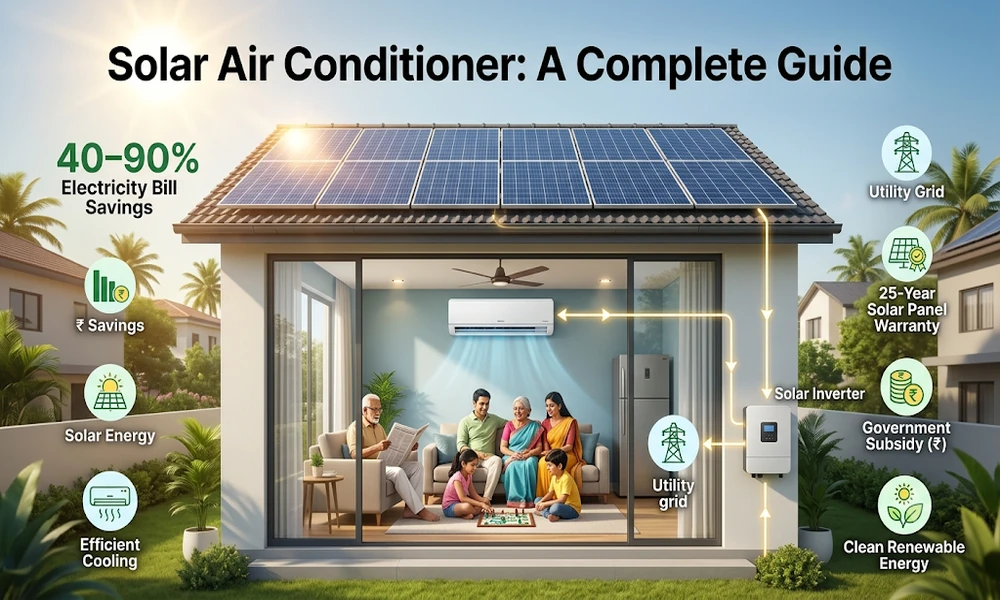
Running an AC through the Indian summer is non-negotiable for most families. But check your electricity bill in June, and the numbers can be genuinely shocking. A 1.5-ton unit running six to eight hours a day adds up fast, and grid power isn’t getting cheaper. That’s what’s pushing a lot of homeowners toward solar air conditioning, and honestly, the case for it is stronger than ever.
So What Even Is a Solar AC?
At its core, a solar AC cools your space the same way a regular one does. The difference is where it gets its power. Most solar air conditioners can pull from three sources: your rooftop solar panels, a battery bank, or the grid. Sunny afternoon? The panels handle it. Overcast day? It mixes solar and grid. Middle of the night? Runs on the grid like a normal AC.
The switching happens automatically. You don’t touch anything.
The Technical Bit, Kept Simple
Solar panels produce DC power. Your AC needs AC power. A solar inverter sits between the two and handles the conversion. That’s really the heart of the system, and getting a good quality inverter matters more than most buyers realise when they’re comparing options.
What Does It Actually Cost?
In 2026, a 1-ton hybrid solar AC in India runs somewhere between Rs 75,000 and Rs 90,000 for a complete setup. A 1.5-ton unit costs closer to Rs 95,000 to Rs 1.2 lakh. These figures include the panels, inverter and basic installation. Panel warranties typically run 25 years, with around 5 years on the full system.
Done right, solar cooling can slash your AC electricity costs by 40 to 90 per cent. Payback lands somewhere between 4 and 6 years, depending on how much sun your location gets and how heavily you use the system.
You Probably Don’t Need a New AC
Worth saying clearly: you don’t have to bin your existing air conditioner. A rooftop solar system sized correctly will run your current unit just fine. A 1-ton AC generally needs a 2 to 3 kW setup. A 1.5-ton needs 4 to 5 kW. Yes, the upfront cost is higher than buying a dedicated solar AC, but you also end up powering your fridge, lights and everything else with the same system. Much better value overall.
Don’t Forget the Subsidy
The PM Surya Ghar Muft Bijli Yojana offers financial assistance for eligible residential rooftop solar installations. Currently, homeowners can receive subsidies of up to ₹78,000 for systems of 3 kW and above, helping reduce the upfront investment required to power energy-intensive appliances such as air conditioners.
Whether you’re investing in a dedicated solar air conditioner or powering your existing AC with rooftop solar, choosing reliable technology is key to maximising long-term savings. With over 25.8 GW of solar module manufacturing capacity, Waaree offers high-performance rooftop solar solutions designed to help homeowners reduce electricity costs and make the most of clean, renewable energy.